An illustrative Tessure world
Data center
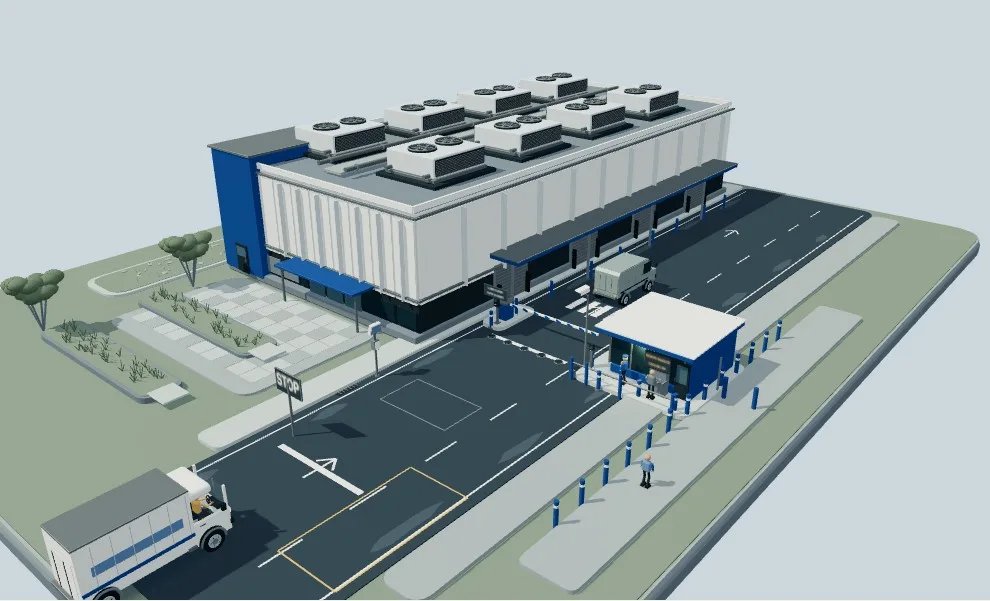
A threatening truck approach and separate rejected control commands prompt a local access hold and guarded verification. Explore the authored incident, the evidence behind the decision and the physical response. This is an authored illustration, not working detection software.
World 02 / Data center
Protect the inner boundary
A threatening truck approach and separate rejected control commands prompt a local access hold and guarded verification.
The illustration plays from beginning to end, including the operator’s review and response. Pause or jump to any moment to explore; these controls do not operate a real site.
The idea this world exploresPhysical access and command authority are separate. Correlate relevant evidence, protect the inner lane, then verify the truck and controller locally.
Read the story as text
Vehicle approach + control anomaly
A working campus, two access boundaries
Authored red-team simulation. A legitimate service van clears the inner lane. Staff use a protected path; a truck approaches the outer stop instruction. Cooling and site power remain on.
The truck closes on the stop line
The fictional red-team driver accelerates toward the restricted approach. The fixed radar contributes motion and distance; the camera supplies a separate view.
Approach radar: An approaching vehicle accelerates toward the marked stopping position.
Past the outer instruction
The truck passes STOP without waiting. The secure inner gate remains closed; the open apron is not containment.
Fixed gate camera: The truck crosses the outer stopping line and continues toward the inner boundary.
A separate control anomaly
The local access controller rejects unauthorized open commands. This record is independent of the truck observation.
Local access controller · illustrative: Remote open requests rejected; closed gate contact unchanged.
Attribution: The controller record does not establish that the driver sent these commands.
Observe the approach; check the controller
The fixed camera confirms continued approach. The panel radar contributes the approaching track. The local controller independently reports rejection, rather than a successful opening.
Camera + fixed-panel radar: A moving truck occupies the authored approach sector. No plate, face or intent recognition is claimed.
Gate contact: Closed.
A fixed camera sees the approach
The lens is aimed down the approach. Its contribution is the visible truck and boundary crossing, not the driver’s identity or intent.
Fixed gate camera: Truck continues along the restricted approach.
A fixed panel contributes the track
The aimed panel radar independently contributes the moving approach track. Its illustration does not require a rotating scanner or claim calibrated range.
Approach radar: Approaching truck remains in the authored sector.
Presence in the inner approach
The ground loop indicates lane presence while the gate contact stays closed. These are different physical states.
Lane detector + gate contact: Approach occupied; gate closed. The controller continues to reject open requests.
Hold the inner access
Proposed on-site correlation groups the relevant approach and controller records. A preauthorized access hold raises the inner bollards while their swept lane is empty; the truck brakes.
Proposed local correlation: Related place and time group physical and control evidence; this is not proof of a common source.
Preauthorized access policy: Inner bollard hold begins with the lift area empty. Gate remains closed.
Bollards up before arrival
The bollards reach full height before the truck reaches them. The protected inner lane remains closed.
Inner-access state: Bollards raised; gate closed; no vehicle above the moving mechanisms.
The truck stops short
The driver brakes to a stop before the raised bollards. The driver remains at the controls; nobody enters the truck’s path.
Camera + lane presence: Truck stationary outside the protected inner boundary.
The operator reviews the access hold
The on-site operator reviews the stopped truck, secured inner lane and rejected command record, then authorizes local-only gate commands and an on-site check. Cooling and site power continue.
Illustrative decision: Operator review: keep access closed and verify locally.
Current access state: Truck stopped; inner gate closed and bollards raised.
Investigation: Vehicle authorization and the source of the rejected commands remain under review.
An operator takes local authority
Following the on-site review, the local operator uses the physical console. The guard moves to the protected inspection point and staff move behind the inner boundary.
Authorized local response: Operator begins the local-only command-path change; the guard and staff stay on protected paths.
Remote commands isolated locally
The console now shows LOCAL ONLY. Cooling stays on. This is local access-command isolation, not a claim of network-wide protection.
Local controller: Local-only gate-command authority selected; cooling indication unchanged.
A protected direction to the driver
The guard reaches the intercom point behind steel protection and directs the truck toward the open holding apron. Staff continue along the protected path.
Gate team: Guard in protected position; driver prepares the reverse maneuver.
Reverse into the holding apron
The driver steers and reverses away from the secure inner boundary under guard direction. The wheels roll backward; the truck does not turn in place.
Authored physical response: Reverse motion begins after a stopped steering setup.
Stop, then change steering
The truck pauses partway through the reverse maneuver. The driver changes the steering before continuing into the marked bay.
Vehicle state: Truck stationary during the change in steering direction.
Align with the open bay
A second reverse arc straightens the truck into the holding apron. Staff are now behind the protected inner boundary.
Gate team + staff: Truck continues under guard direction; staff remain separated from the vehicle sweep.
Stopped under guard direction
The truck stops in the open outer apron. The inner barrier stays secure. The truck is not physically contained by this open bay.
Holding-apron view: Truck stopped in the marked bay, away from the inner gate.
Inspect the held lane and controller
The truck remains stopped under guard direction while the guard checks the protected lane/intercom and the operator checks local access state.
Gate team: Truck held in the open apron; inner barrier remains secure.
Follow-up: Authorization and source attribution are still under review.
A local check, with questions retained
The record joins the stopped truck, rejected remote commands and completed local access check. Cooling continues. It does not establish driver attribution, network-wide protection or absence of data loss.
Local access check: Closed gate and raised bollards checked; command authority remains local-only.
Controller record: Rejected remote open commands retained with the physical approach record.
Investigation: Truck authorization and the control anomaly’s source remain unresolved.